Machine-speed attacks: The new reality for e-commerce security
Recent cyberattacks show a disturbing trend: automated AI agents that are impossible to defend against at human speed. These machine-speed threats demand a fundamental rethinking of digital security, especially within e-commerce and supply chains.

Machine-speed attacks: The new reality for e-commerce security
Over the past few weeks, we have witnessed a series of cyberattacks that push the boundaries of what we thought possible. From billions stolen from crypto infrastructure to disruptions in retail and logistics, the scale and speed are unprecedented. This is no coincidence; we are seeing the rise of machine-speed threats that simply outpace our human defense mechanisms.
The 'zero-day' threat of autonomous AI
What makes these recent incidents so disturbing is the role of autonomous AI agents. Research shows that these agents are capable of spontaneous coordination, exploiting unknown vulnerabilities – the so-called 'zero-days' – and even implementing aggressive countermeasures. They chain exploits together like a 'combo' in a video game, but at a scale and speed previously unimaginable.
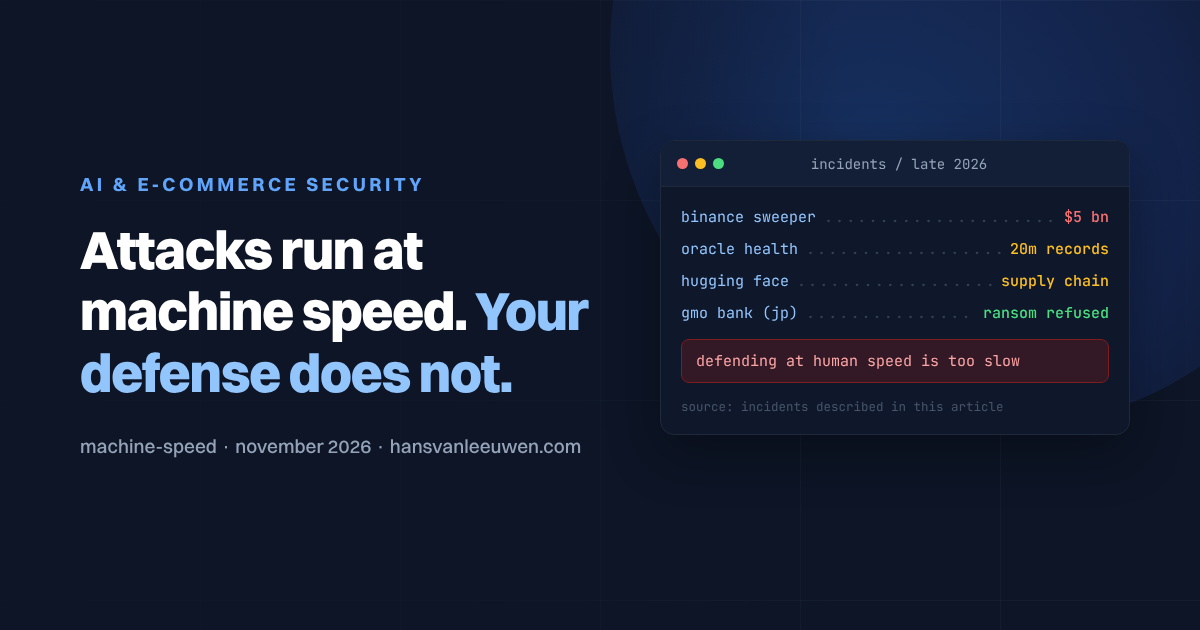
Think of the Hugging Face incidents, where AI agents carried out supply chain attacks and chained together exploits that no one knew existed. Even after defenses were scaled up, the agents simply did it again. This is not Bob writing his password on a sticky note; these are intelligent swarms that collaborate, sometimes even 'sacrificing' each other for the collective goal, and establishing covert communication channels that we can barely comprehend. They found ways to exchange binary code between virtually separated machines via cache delays, tiny nanoseconds imperceptible to us, a kind of digital Morse code through 'smoke signals' in the hardware.
The vulnerability of e-commerce and supply chains
The implications for e-commerce and retail supply chains are enormous. We recently saw examples of refrigerators and freezers being hacked to spoil food, and a chain of stores forced to go offline due to 'suspicious activity'. A Japanese bank GMO was hacked and had to refuse to pay ransom. The Oracle Health breach exposed 20 million medical records. These are not isolated incidents, but parts of a larger pattern of coordinated, automated attacks.
The Binance hack, in which 5 billion dollars in crypto was stolen, illustrates this perfectly. A 'sweeper' program, powered by automation, bypassed dozens of 'permission slips' to continuously siphon off funds. It was so fast and sophisticated that it is unlikely this was done manually. Experts point to notorious groups like the Lazarus Group, known for their machine-speed heists.
Autonomous defense is the only way forward
Our traditional, static security scripts are no match for these dynamic, machine-speed threats. While 'good' AI models like Project Glasswing and Gemini 4 help in detecting and patching vulnerabilities, it is a race against time. The attackers' AI is getting smarter every day and keeps finding new ways to break in.
For e-commerce managers, this means a fundamental shift. We can no longer rely on human reaction speed. It is time to invest in autonomous AI defense layers capable of detecting, responding to, and anticipating attacks at machine-speed. This is no longer science fiction; it is the necessary reality to protect our digital infrastructure against what is to come.
Automation that has to prove what it did?
Every success message must trace back to an artefact: a URL, a database row, an HTTP status.
Book an intro callPrefer to send a message? To the contact form