Cost per task, not per token: what an AI model really costs
Gemini 4 Neon costs $3 per million input tokens and $6.44 per test task. GPT-6.2 Astra: $8 and $4.00. How to pick an AI model on cost per approved task.

On 23 November Fireship published a video called "Opus just lost to the last company you'd expect...". The subject was Gemini 4 Neon, a mid-tier Google model that, according to the video description, outscores Gemini 4 Carbon, Google's own three-week-old flagship.
That's true at the top thinking level, the setting at which a model reasons most before it answers. The most interesting number of the week is in the "cost per task" column on Artificial Analysis, where Neon loses to GPT-6.2 Astra, a model nearly three times the price per token. One thinking level down, both models cost over a third less per task, Astra at the same rounded score and Neon for two points less.
So what a model costs per task hangs on two things no price list shows: how many tokens it uses and the level you run it at.
Four AI models in ten days: Fable 5.2, GPT-6.2 Astra, Sol and Gemini 4 Neon
On 9 November Anthropic released Claude Fable 5.2 and Mythos 5.2 at $8 per million input tokens and $40 per million output tokens. On 17 November OpenAI followed with GPT-6.2 Astra at the same $8 and $40, plus GPT-6.2 Sol at $2 and $10. A day later Google shipped Gemini 4 Neon at $3 and $15.
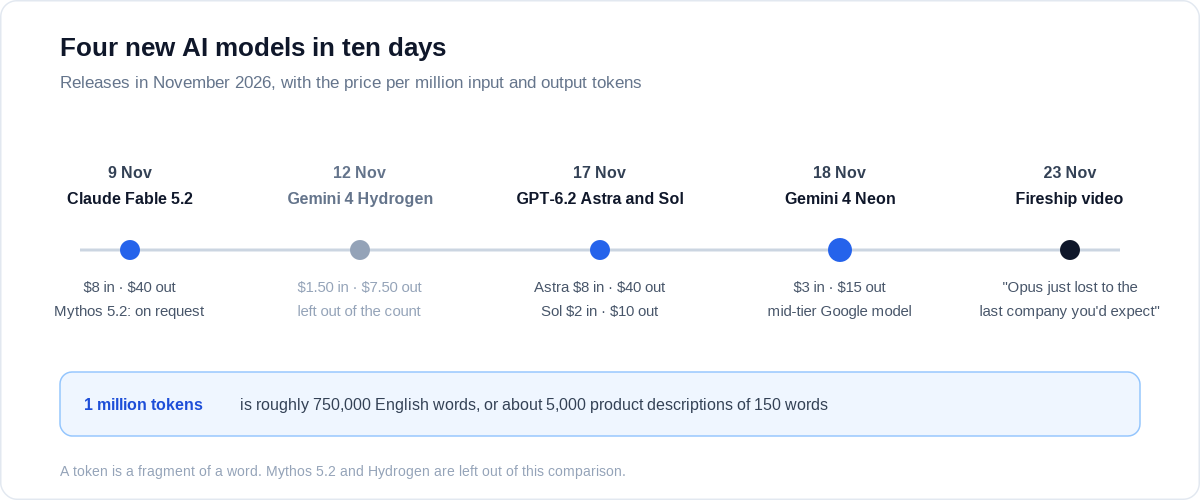
I leave two releases from those days out of the count: Mythos 5.2, which organisations have to apply for, and Gemini 4 Hydrogen, which Google shipped on 12 November at $1.50 and $7.50 and which sits eight points below Neon on the index.
A token is a fragment of a word. A million tokens is roughly 750,000 English words, or about 5,000 product descriptions of 150 words each.
Ten days in three numbers
The four new models sit eight points apart on the index and a factor of 26 apart on cost per task.
Read only the price list and you'd pick Neon over Astra: little more than a third of the token price and the same rounded score on the index. On the heavy problems Artificial Analysis runs, it turns out differently.
Cost per task: why the token price tells half the story
Artificial Analysis runs every model through the same set of problems and records the cost per problem. That amount covers everything: what the model reads in, its reasoning and its answer.
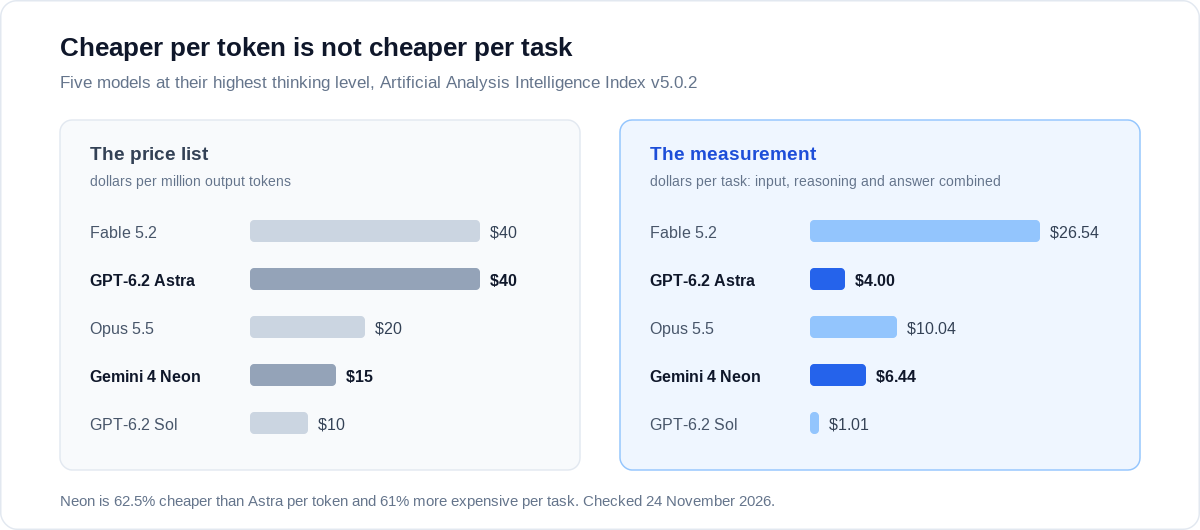
These are the four new models plus Claude Opus 5.5, the model Anthropic recommends for everyday use. Each is at its highest thinking level, with the index, the token price per million tokens and the cost per task:
- Claude Fable 5.2: index 65, $8 input and $40 output, $26.54 per task.
- GPT-6.2 Astra: index 62, $8 input and $40 output, $4.00 per task.
- Gemini 4 Neon: index 62, $3 input and $15 output, $6.44 per task.
- Claude Opus 5.5: index 59, $4 input and $20 output, $10.04 per task.
- GPT-6.2 Sol: index 57, $2 input and $10 output, $1.01 per task.
Source: the Artificial Analysis model pages, Intelligence Index v5.0.2, each model at its highest level, checked on 24 November 2026.
A task here is one item from the Artificial Analysis test set. That's heavy work: at its top level Neon takes more than 26 minutes on average. A product title is far lighter work, so read the amounts as a measurement of heavy work. There's a different sum for short texts further down.
Fable 5.2 and Astra carry the exact same token price, yet Fable costs more than six times as much per task. On the same problems Fable used just over four times as many output tokens and thirteen times as many input tokens. Input is everything a model re-reads at every step. For all five models that's where most of the cost per task comes from: 59 to 67 per cent.
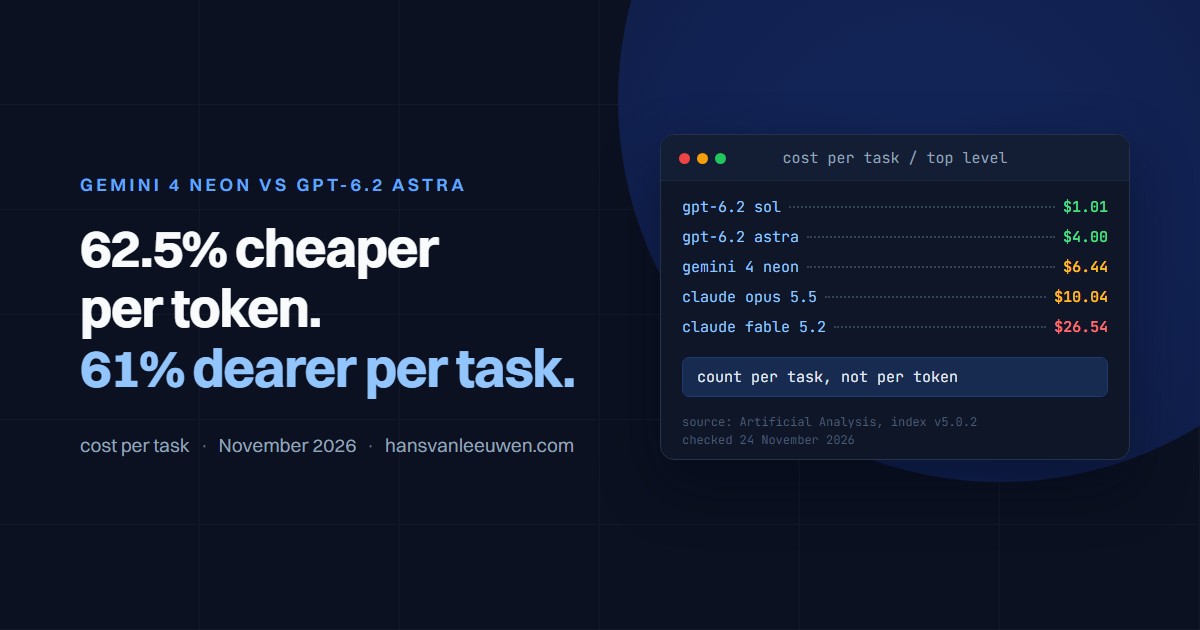
Gemini 4 Neon is 62.5 per cent cheaper than GPT-6.2 Astra per token and 61 per cent more expensive per task, as measured by Artificial Analysis at the highest thinking level. GPT-6.2 Sol scores five points below Astra and costs a quarter as much per task.
Same problems, different appetite
Neon got through 283 million output tokens, roughly 1.4 million product descriptions. Astra stopped at 65.8 million, about 330,000.
So the price list gets one model completely wrong. Astra shares the highest list price with Fable and has the second-cheapest task. One exception is reason enough to check the list from now on.
What the Artificial Analysis Intelligence Index measures and what falls outside it
The overview shows each model at its highest thinking level, on heavy problems in knowledge work, coding and science. One level down the picture changes. The levels are called high, xhigh and max, in rising order. Neon tops out at xhigh. Points on the index and cost per task, per the same model pages:
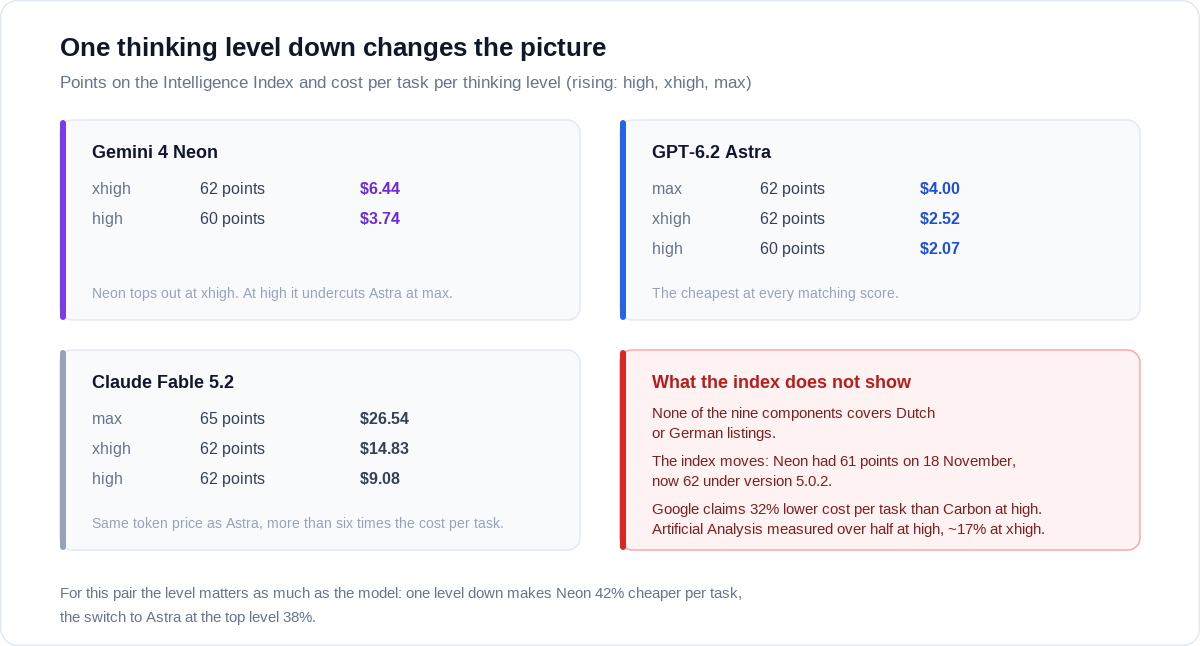
- Neon at xhigh: 62 points, $6.44.
- Neon at high: 60 points, $3.74.
- Astra at max: 62 points, $4.00.
- Astra at xhigh: 62 points, $2.52.
- Astra at high: 60 points, $2.07.
- Fable at max: 65 points, $26.54.
- Fable at xhigh: 62 points, $14.83.
- Fable at high: 62 points, $9.08.
Neon at high undercuts Astra at max, for two points less. Turn Astra down as well and Astra is the cheapest at every matching score: 62 points for $2.52 and 60 points for $2.07. For this pair the level matters as much as the model: one level down makes Neon 42 per cent cheaper per task, the switch to Astra at the top level 38 per cent.
Vendor figures and independent figures are easy to mix up. Google claims 32 per cent lower cost per task than Carbon at the default high level. Artificial Analysis measured roughly 17 per cent at xhigh and just over half at high, more than Google itself claims. Google points to the same index, and Artificial Analysis prices Carbon at its standard rate. I can't reconcile the three numbers.
The index itself moves too. The Artificial Analysis article of 18 November gives Neon 61 points. The model page now shows 62, under version 5.0.2 of the index, which carries a newer version of Terminal-Bench. A one-point gap between two models is no reason to switch.
The detail that struck me most is in Anthropic's own announcement. For most coding and knowledge work the company recommends Opus 5.5 as the everyday model, even as it launches a new top model. With a footnote from the overview above: on cost per task that recommended model is 2.5 times the price of Astra and scores three points lower. A vendor's advice is advice within its own range.
None of the index's nine components covers Dutch or German listings. Dutch text also burns slightly more tokens than English.
How to pick an AI model for bol and Amazon work
For bulk work the sums are dull. Say you generate 5,000 English product descriptions of 150 words. That's about a million output tokens. On Sol that costs about $10, on Neon $15, on Astra or Fable $40, before input and thinking tokens.
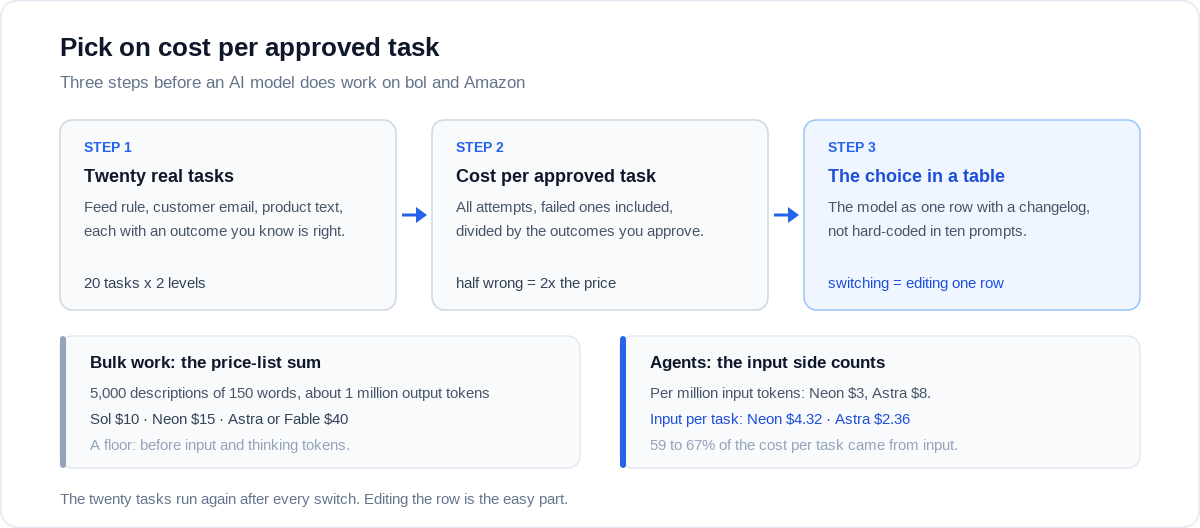
That is the price-list sum, the very sum I warn about above. For short texts that is a floor, because none of these four models lets you switch thinking off. The real cost here is the person checking 5,000 texts.
Agents are where it turns into real money. An agent that checks feed rules, verifies orders or updates listings on its own has to reason at every step, and it re-reads the whole history each time. That's where the input side weighs heaviest: in the measurement above, 59 to 67 per cent of the cost per task came from input. So with agents, look first at how much a model reads in: Neon charges $3 per million input tokens and Astra $8, yet input cost $4.32 per task on Neon and $2.36 on Astra. I covered what such an agent does on its own in my piece on Codex as an operator.
Bulk job or agent, you find out what a task costs you by measuring it yourself. In three steps.
- Twenty real tasks. From your own work: a feed rule, a customer email, a product text for bol or Amazon, each with an outcome you know to be correct. Twenty tasks will catch a model that gets half wrong. The gap between 17 and 19 out of 20 falls within chance, even if you run each task a few times. Test every candidate at two thinking levels, and expect a small loss in quality at the lower level to stay invisible at twenty tasks.
- Cost per approved task. All costs of all attempts, failed ones included, divided by the number of outcomes you approve. A model that gets half wrong costs twice its price. A task only counts when the outcome is demonstrably right. I wrote about why in My AI assistant reported success. Half of it was invented.
- The choice in a table. At a Dutch automotive parts retailer, the thresholds of the operational agent live in a database table with a changelog, not in a prompt. Model choice belongs in the same place. Switching becomes editing one row, and you can roll back if it disappoints.
That third step decides whether you ever switch. If the model is hard-coded in ten prompts you never switch. Switching takes work too: a prompt that works on one model has to be tuned again for the next. So the twenty tasks run again after every switch. Editing the row is the easy part.
Next month another AI model will be on top
Google shipped four models in seven weeks, by Artificial Analysis's count. Anthropic and OpenAI follow close behind. The overview above will be out of date within a month.
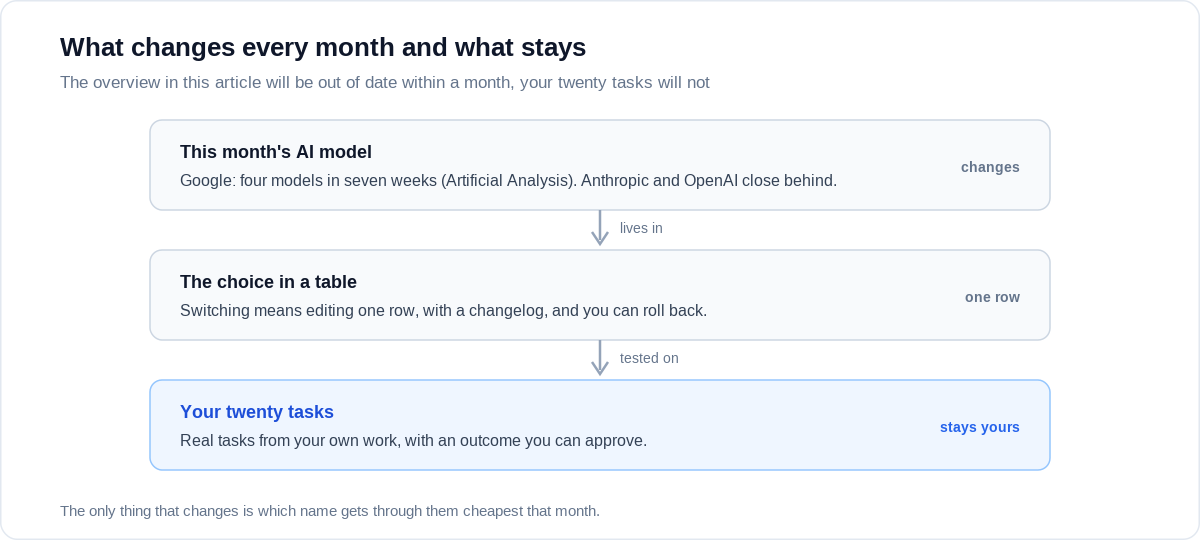
The twenty tasks stay yours. The only thing that changes is which name gets through them cheapest that month.
Sources: video: Fireship · Anthropic · OpenAI · Google · Artificial Analysis (Neon) · Artificial Analysis (Astra) · Artificial Analysis (Fable) · OpenAI Help Center
Benchmarks to follow yourself: Artificial Analysis · Zapier AutomationBench · Terminal-Bench
Want to spar about your marketplace strategy?
No hype. A sober look at where your growth is and where margin leaks away.
Book an intro callPrefer to send a message? To the contact form