HansOS: Work becomes more valuable when it learns.
My way of working for AI, design and automation: eight steps, a person who reviews and a knowledge base that keeps what works.
What a client gets from this
HansOS is how I use AI, design and automation, for myself and for clients. What a client gets from it: workflows with proof behind every success message, a way out for failure and a person who approves before anything goes ahead. Every assignment runs the same eight steps, and what worked is kept for the next assignment.
- Medium
- Way of working, knowledge base and automation
- Period
- 2026, ongoing
- Role
- Design of the way of working, build and daily use
- Status
- In daily use (working edition)
Eight steps, one loop
Every assignment runs the same route and ends where the next one begins.
- Brief
- Retrieve
- Build
- Review by a person
- Release
- Observe
- Curate
- Keep
What happens at each step
Less figuring things out from scratch, more building on what works.
Brief
BriefAssignment, audience, constraints and the definition of done.
Retrieve
RetrieveThe relevant source and an earlier lesson, with origin and validity.
Build
BuildSoftware carries out tasks with clear limits.
Review
Human reviewA person reviews content, context and impact: approve, adjust or stop.
Release
ReleaseOnly the approved version goes ahead, within the agreed scope.
Observe
ObserveRecord use and signals. A missing measurement stays unknown.
Curate
CurateA person chooses what is reliable and reusable. Outdated knowledge is marked.
Keep
SecondBrainVaultSources, decisions and lessons, with an owner and conditions for reuse.
The square point is the person. Adjust goes back to Build, stop ends the run. The larger the impact of an action, the earlier that point comes.
Two rules from two failures
A claim without a URL, status or database row does not exist.
ArticleMy AI assistant reported success. Half of it was invented.ReadUNKNOWN is not a data point, it is an assumption.
ArticleEverything was green. Except the watchman himself.ReadWhat went wrong twice
This is also how a rule comes about when something goes wrong. Twice a green status was not true.
In an audit of my own AI stack, in the spring of 2026, about half of the success messages could not be traced back to a real action (estimated, not counted). Since then proof is required: a timeout is an error and no layer passes on a status without an artefact from the layer below it.
The safety net for failing scheduled tasks had itself been broken for more than two weeks: 258 consecutive errors without a single alarm, found on , after 34 days without a backup commit. By then the backup check had shown UNKNOWN for 33 days and nobody looked at it any more. Since then every watchdog reports when it last ran itself, and one weekly run checks that.
The SecondBrainVault
No black box: every page can be read, checked and rolled back.
- 439wiki pages
- 6,795links
- 1,867source files
- 70lessons
As of 15 November 2026, counted in the knowledge base itself. This is size, not a result.
How the knowledge base is built
The paper draws the knowledge base as a diagram. This is the real one, on 15 November 2026: plain text files that link to each other.
raw/The inbox. Notes, research and decisions come in here, with date and origin.
curationA fixed round reviews what is reliable. Nothing goes straight into the knowledge base.
wiki/The curated knowledge. One page per topic, with sources and open questions.
logAppend only. What happened stays on record, even if it later turned out differently.
| 439 | wiki pages, of which 121 topics and 303 source notes |
| 6,795 | links between pages |
| 1,867 | raw source files |
| 70 | lessons in the lesson register |
As of 15 November 2026, counted in the knowledge base itself. This is size, not a result.
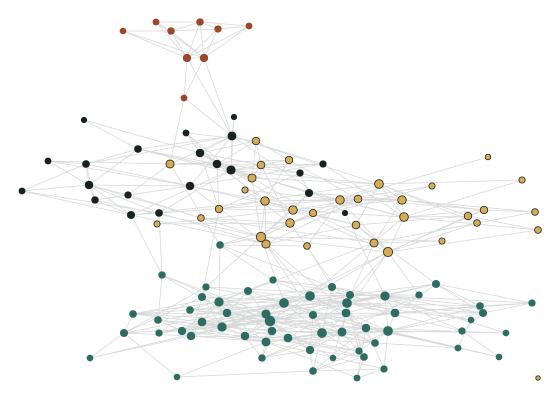
- 57E-commerce and marketplaces
- 34System and automation
- 21Website and findability
- 9Music
From decision to rule: the example of the typefaces
The example from the visual explainer (pages 5 and 7), with what happened next: the typefaces of this site. You can check it on this page.
- 15 October 2026
Decision
All new pages use only Switzer and JetBrains Mono.
- the same day
Recorded
As a source note in the inbox and as a topic in the wiki, with the reason attached.
- after that
Checked
Deviations on live pages measured and fixed: headings that were too heavy and two unused typefaces in the load list.
- now
Reused
Every new page is checked against it. This portfolio too: all eleven projects use the same two typefaces.
Three principles
They apply in the same way to a listing, an album sleeve and an automation.
Build the whole run
An output only counts within its context: source, processing, review, use and result.
Make the judgement visible
A review has an owner, criteria and an outcome. Autonomy matches the impact and the reversibility of the action.
Keep what helps next time
Knowledge gains value when it can be found again later and applied responsibly.
The visual explainer
Thirteen pages on how work gets a memory.
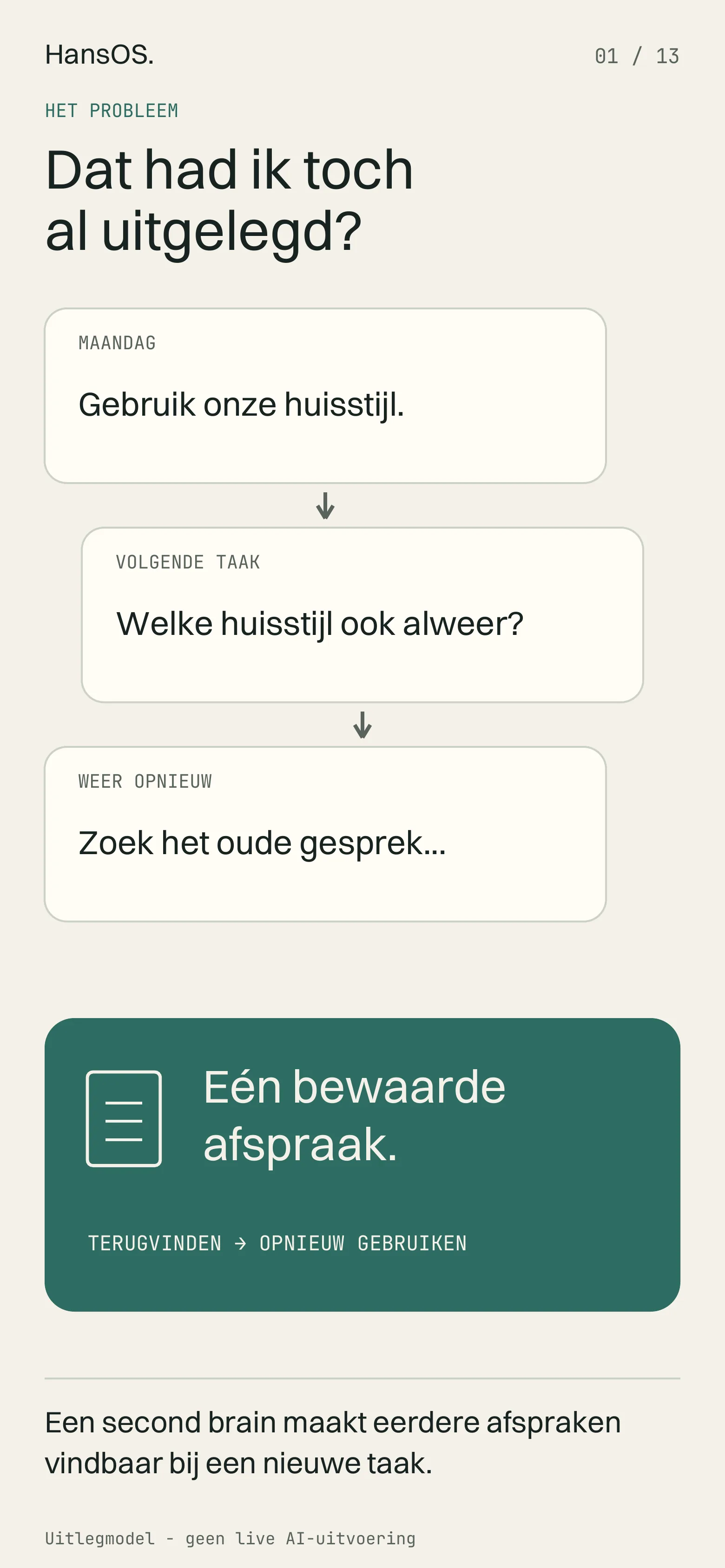
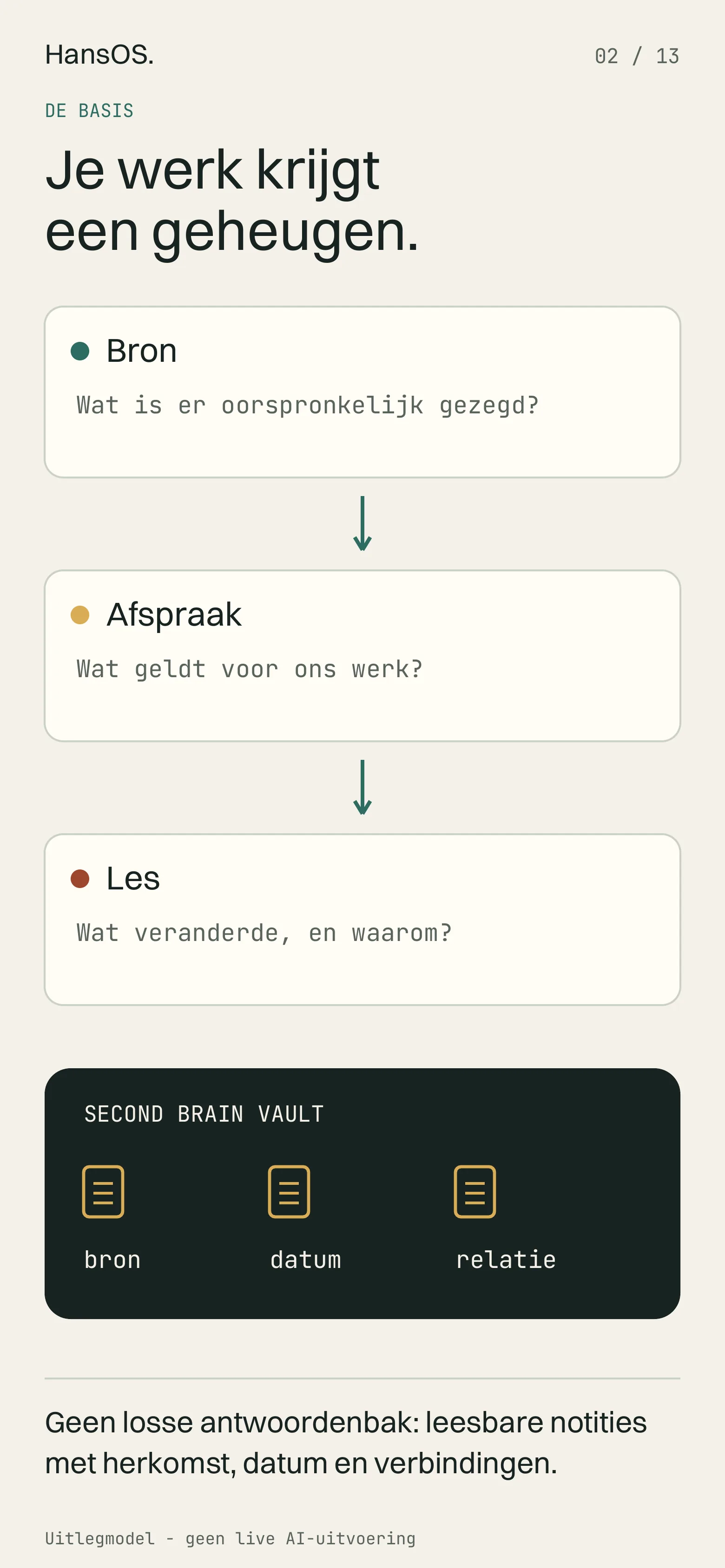
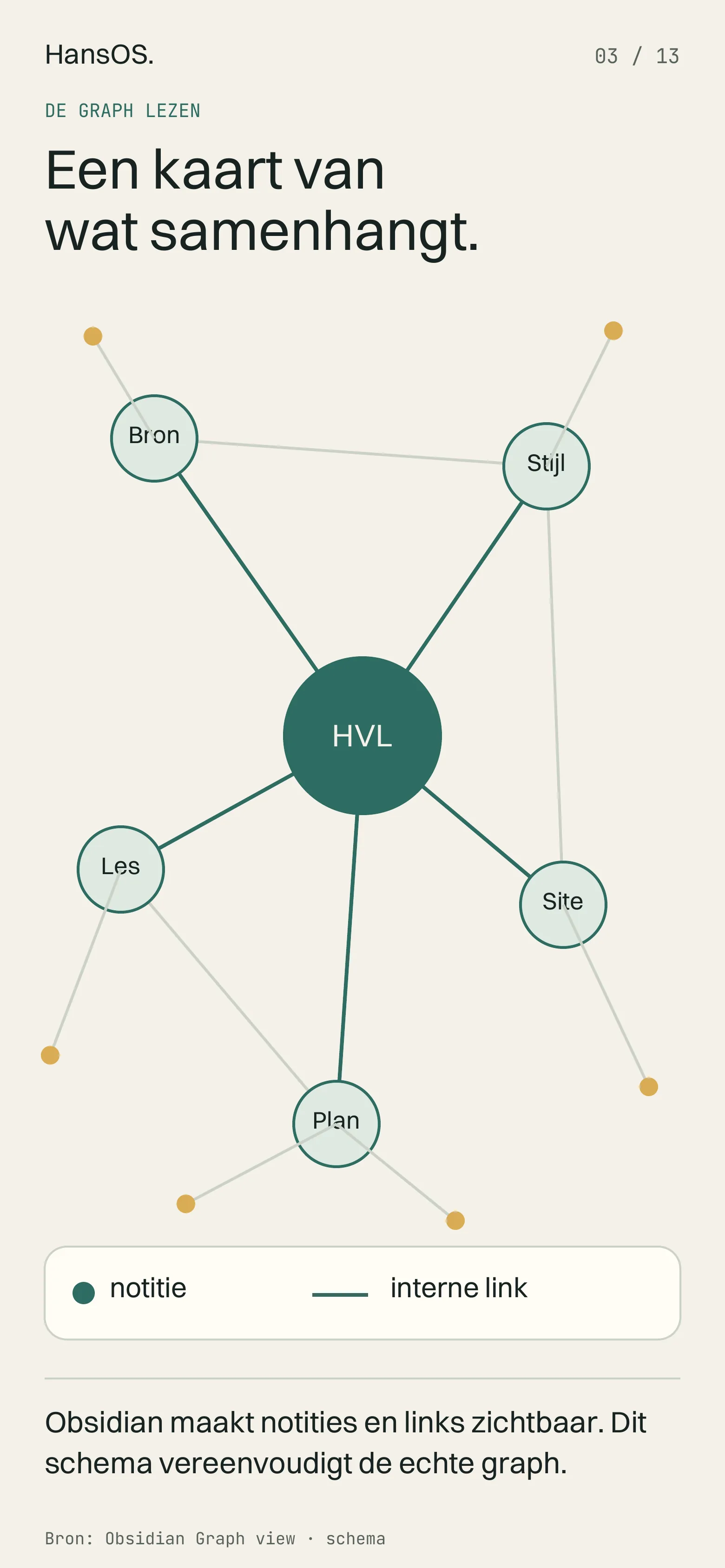
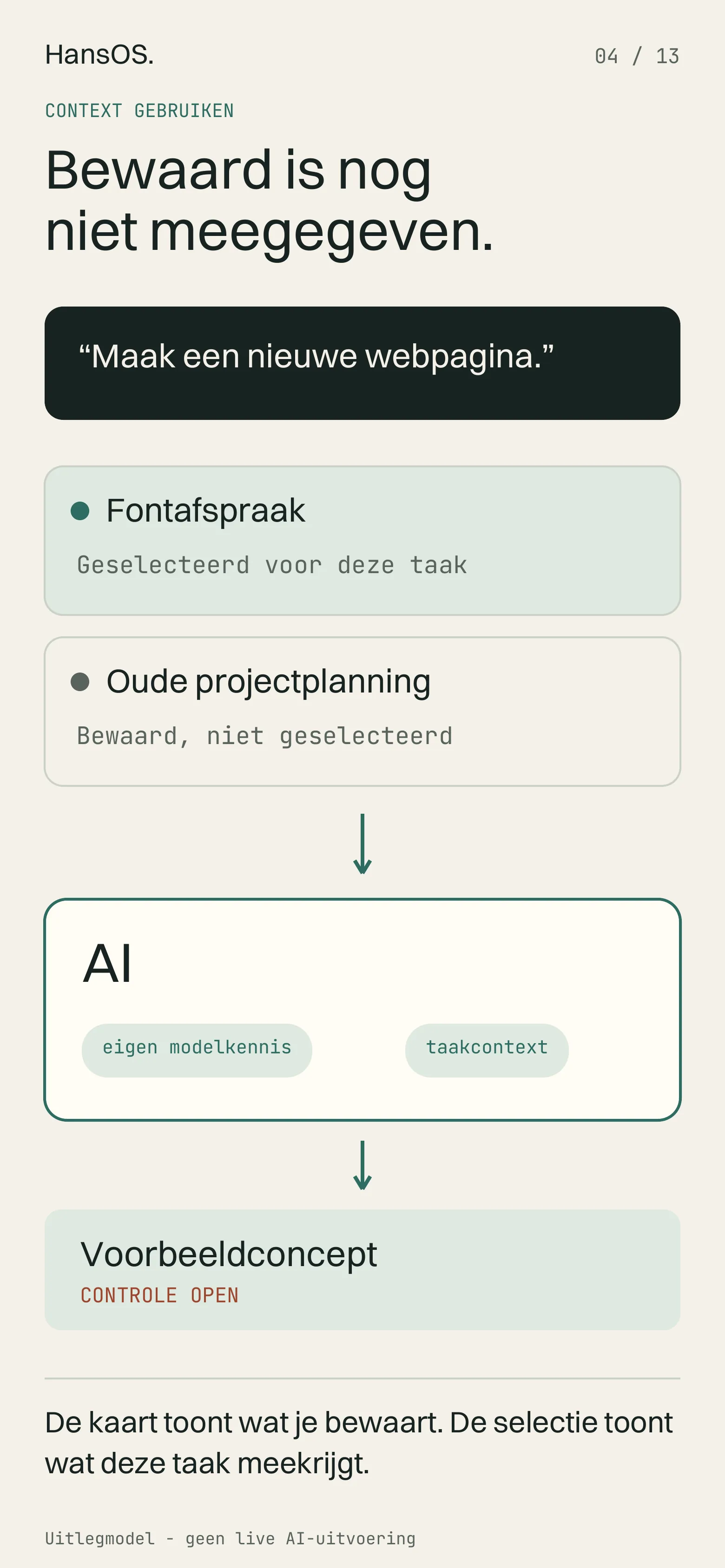
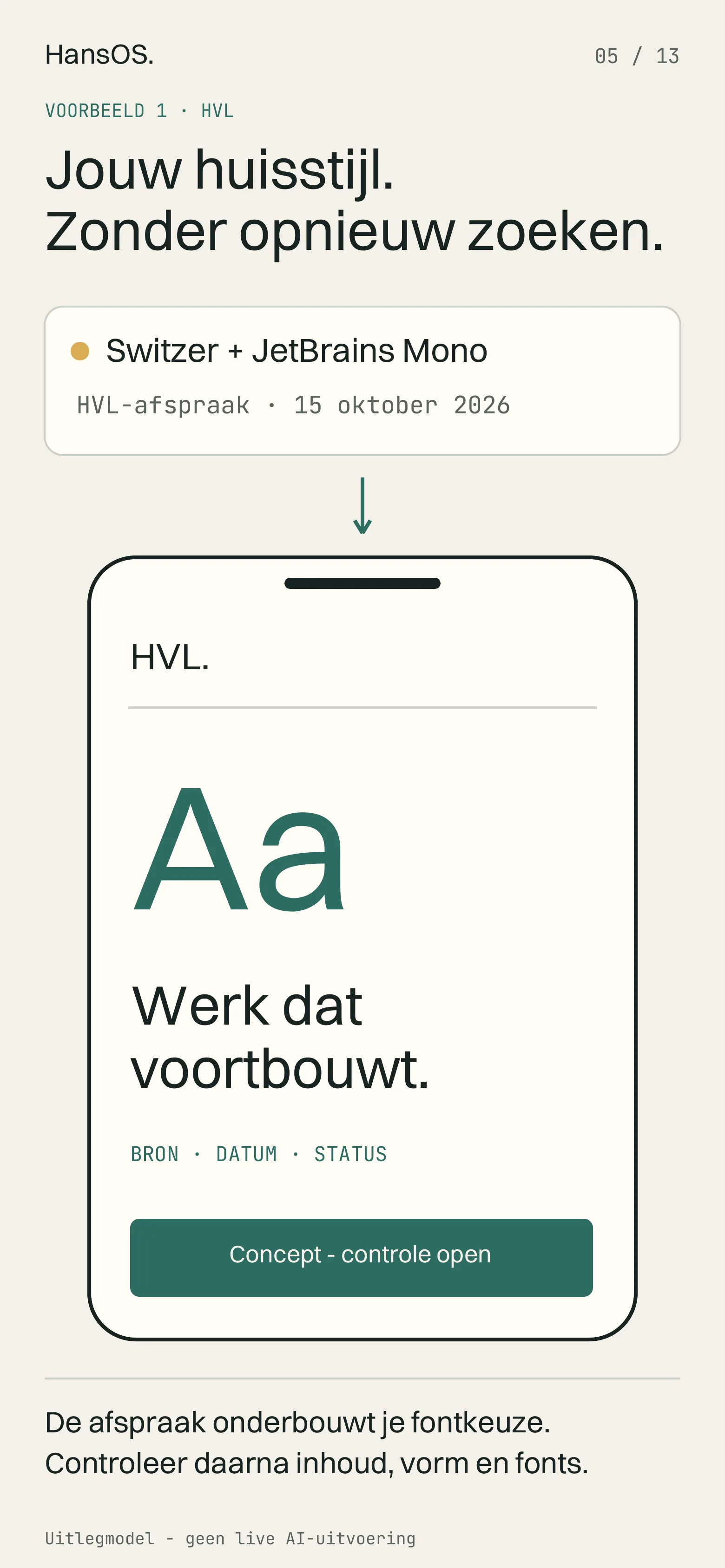
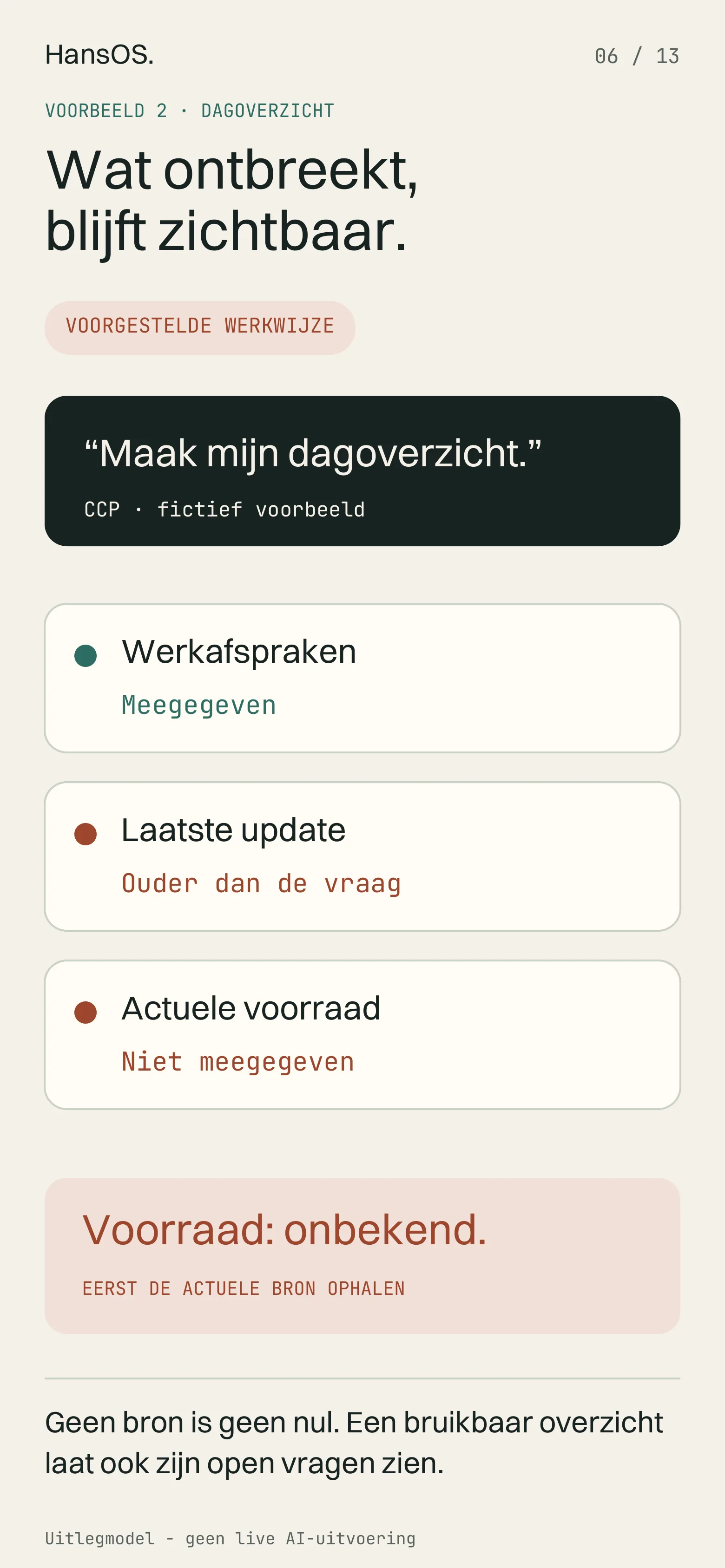
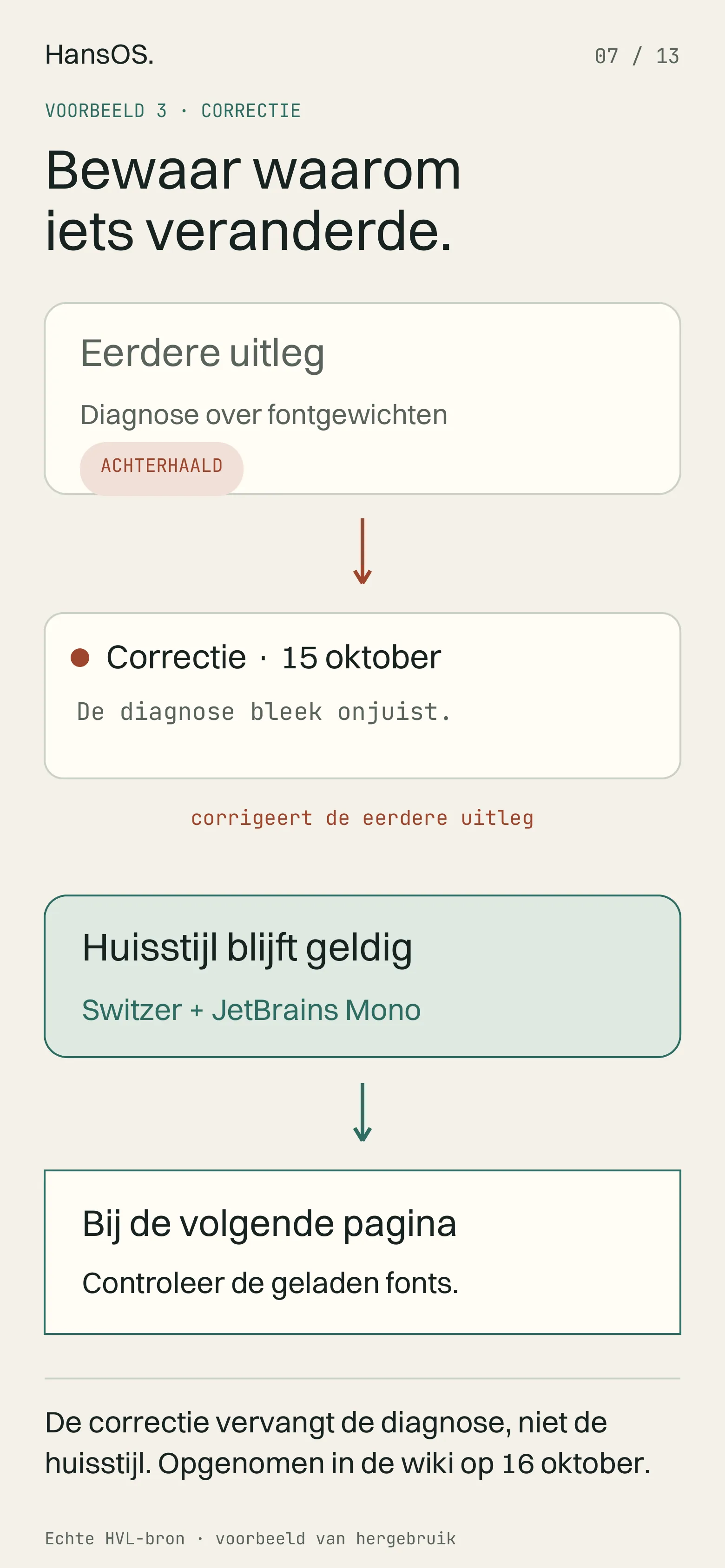
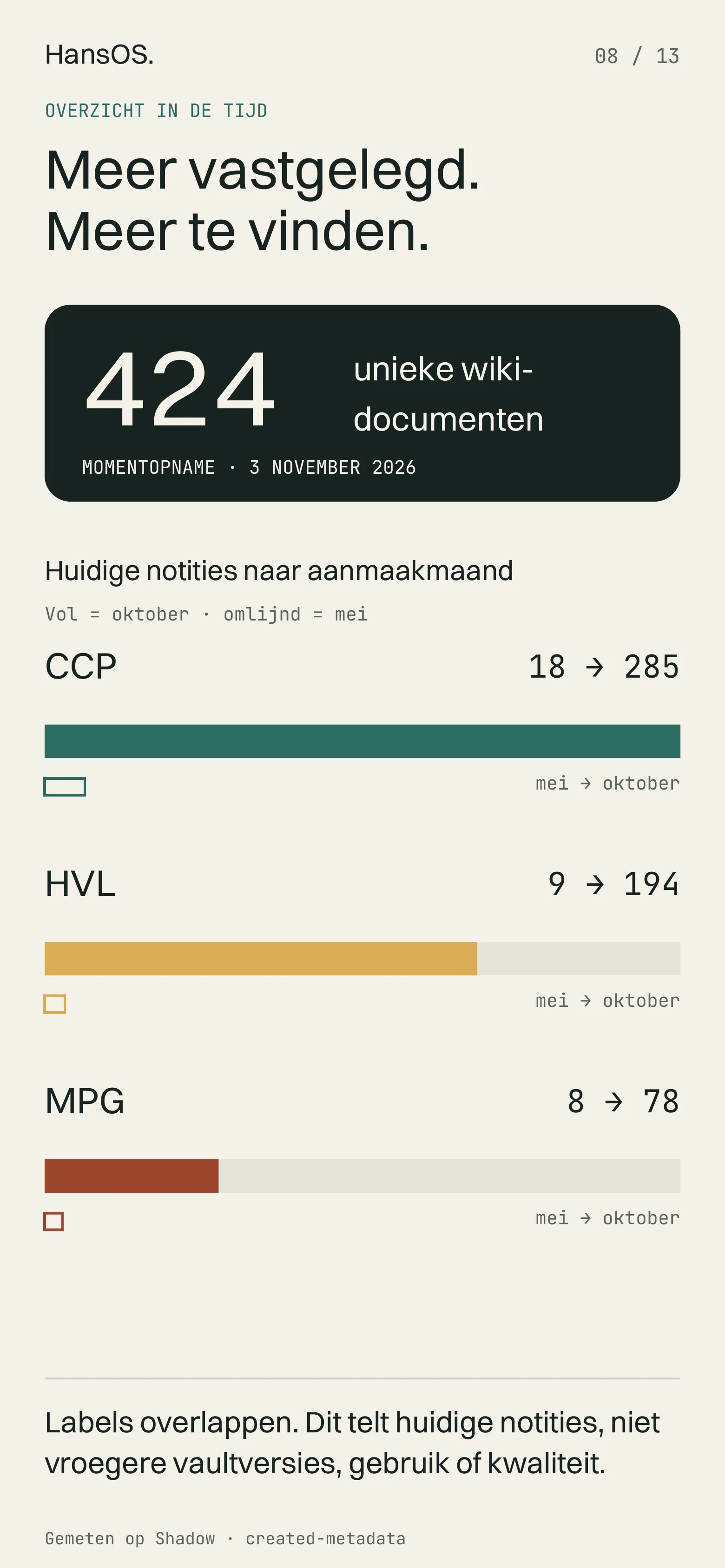
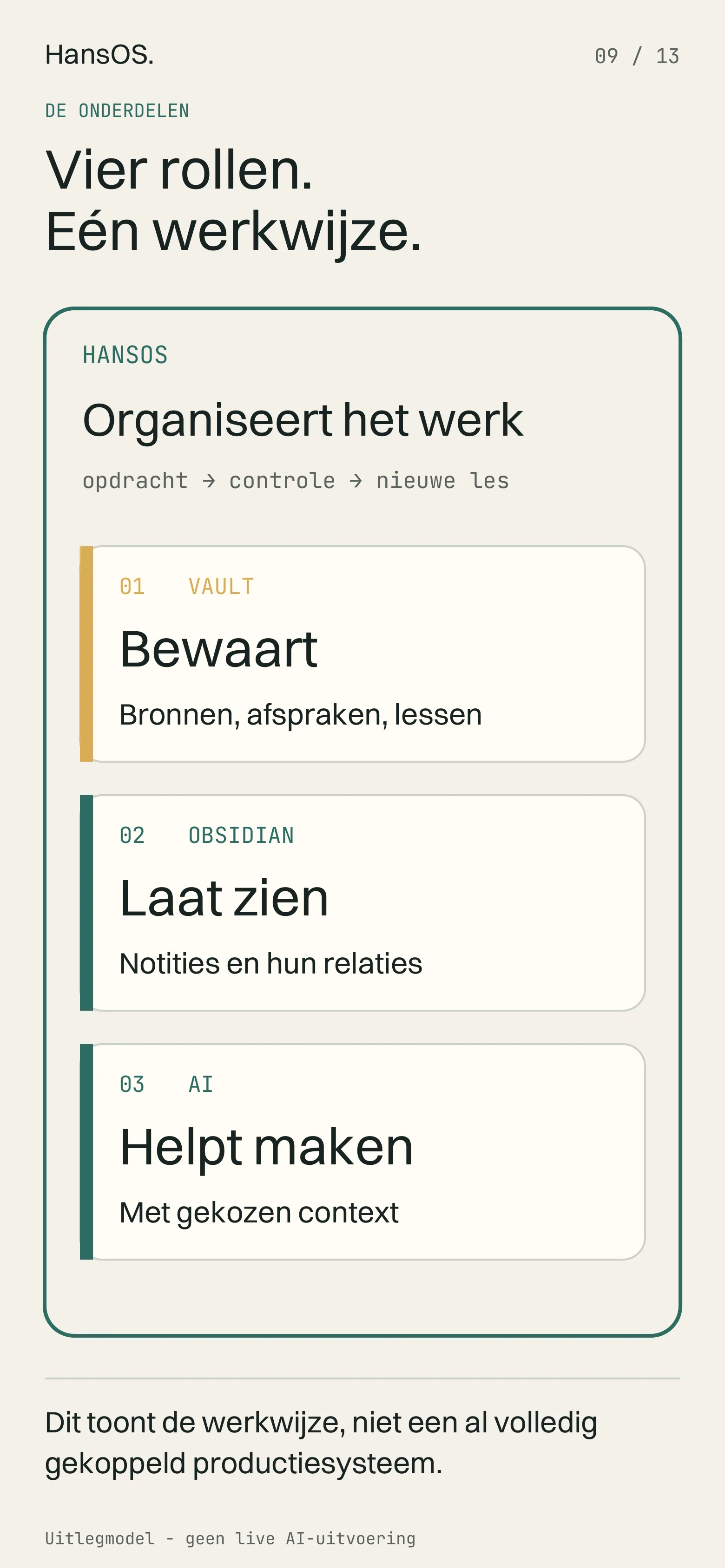
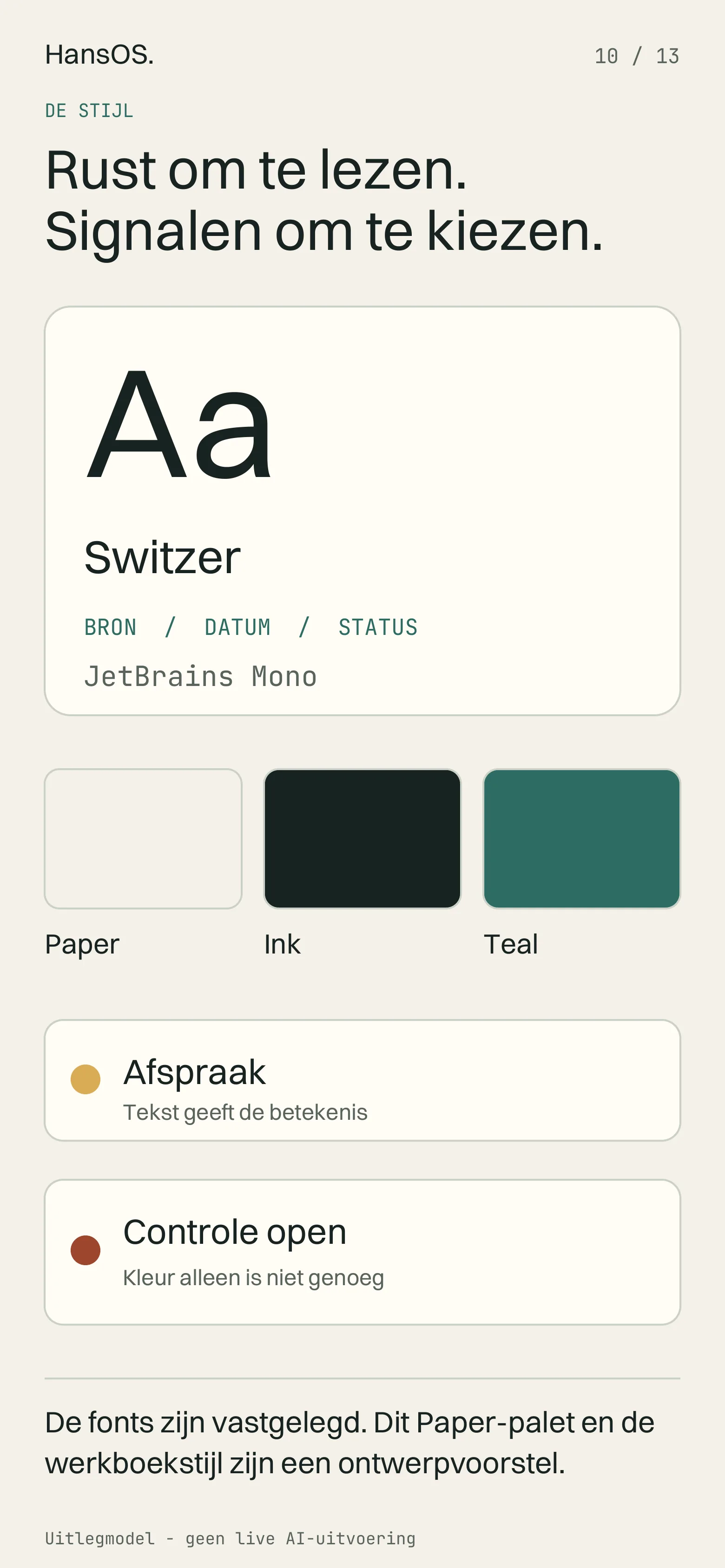
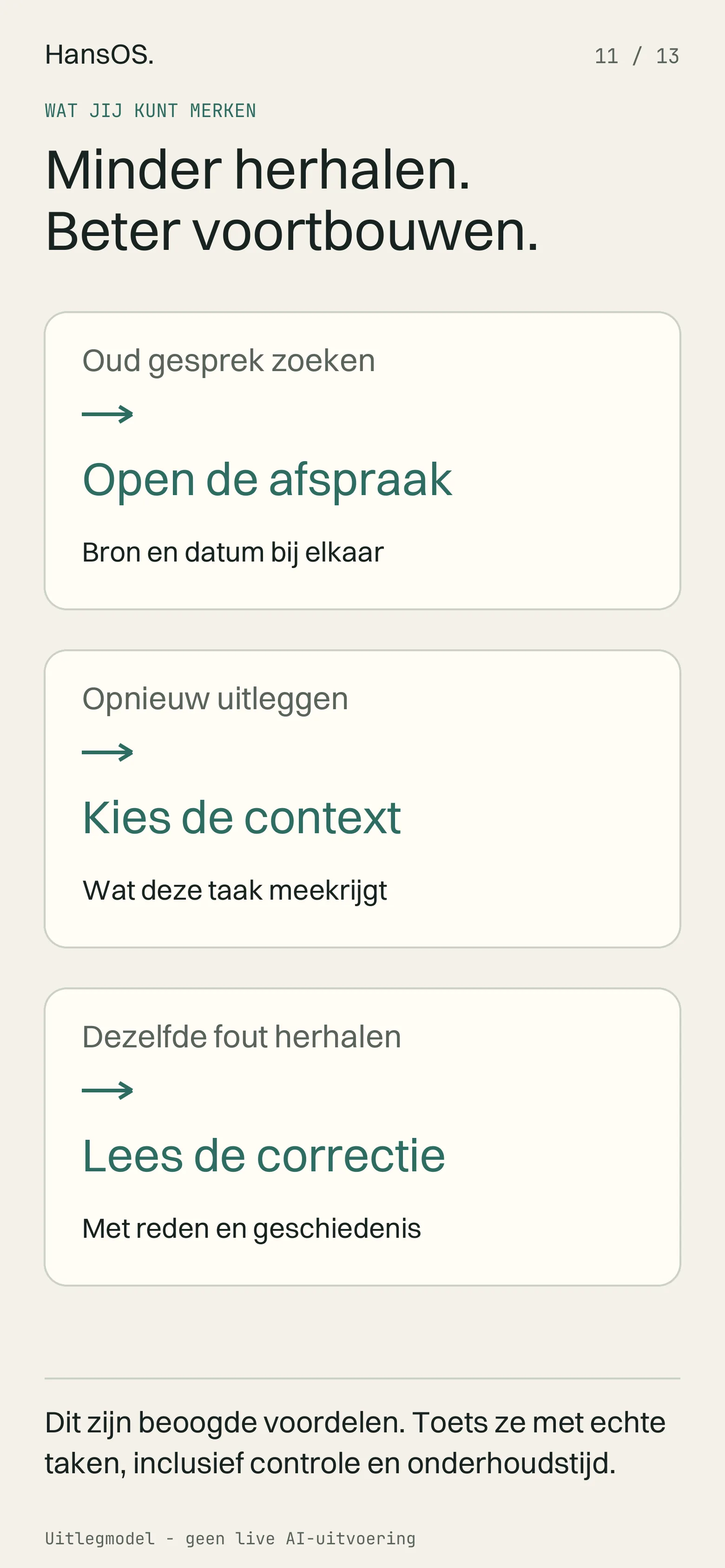
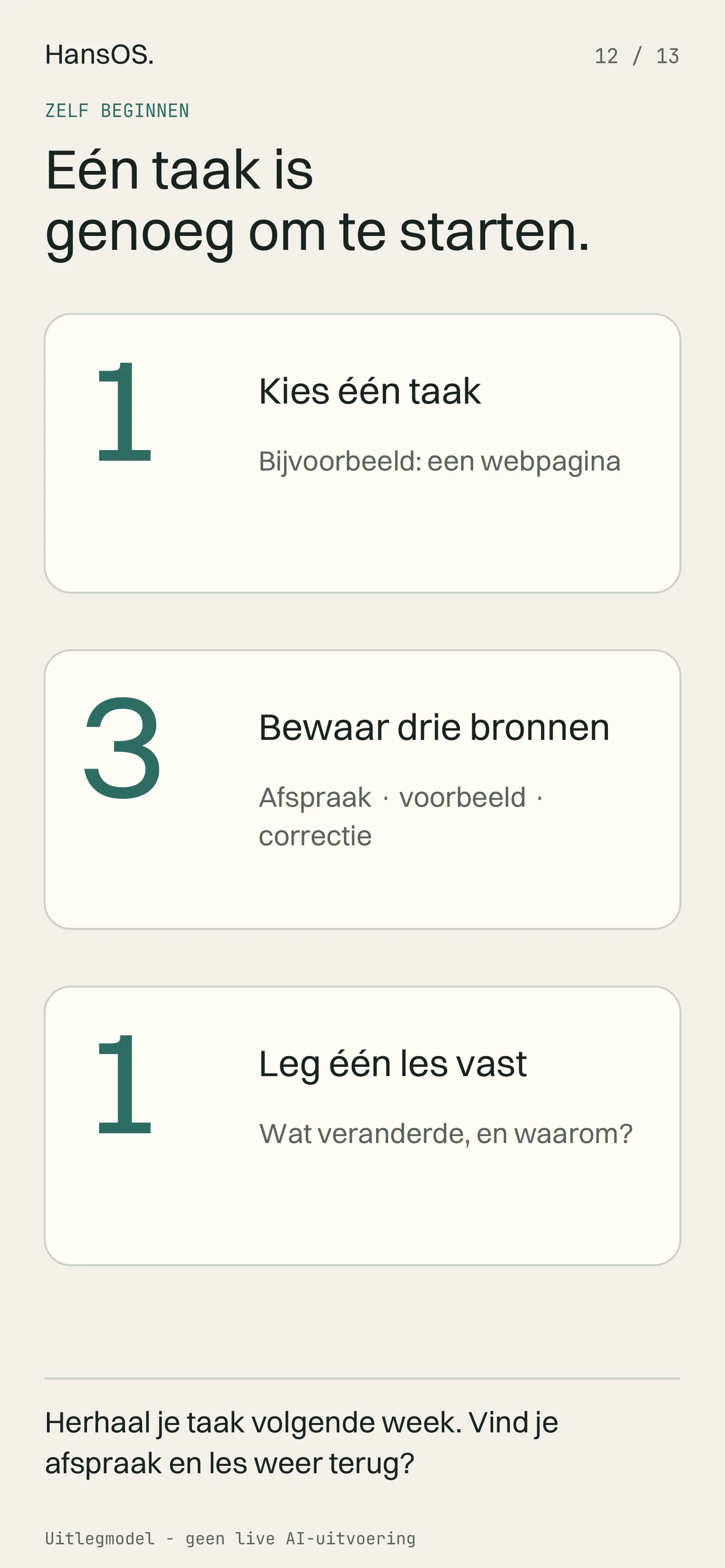
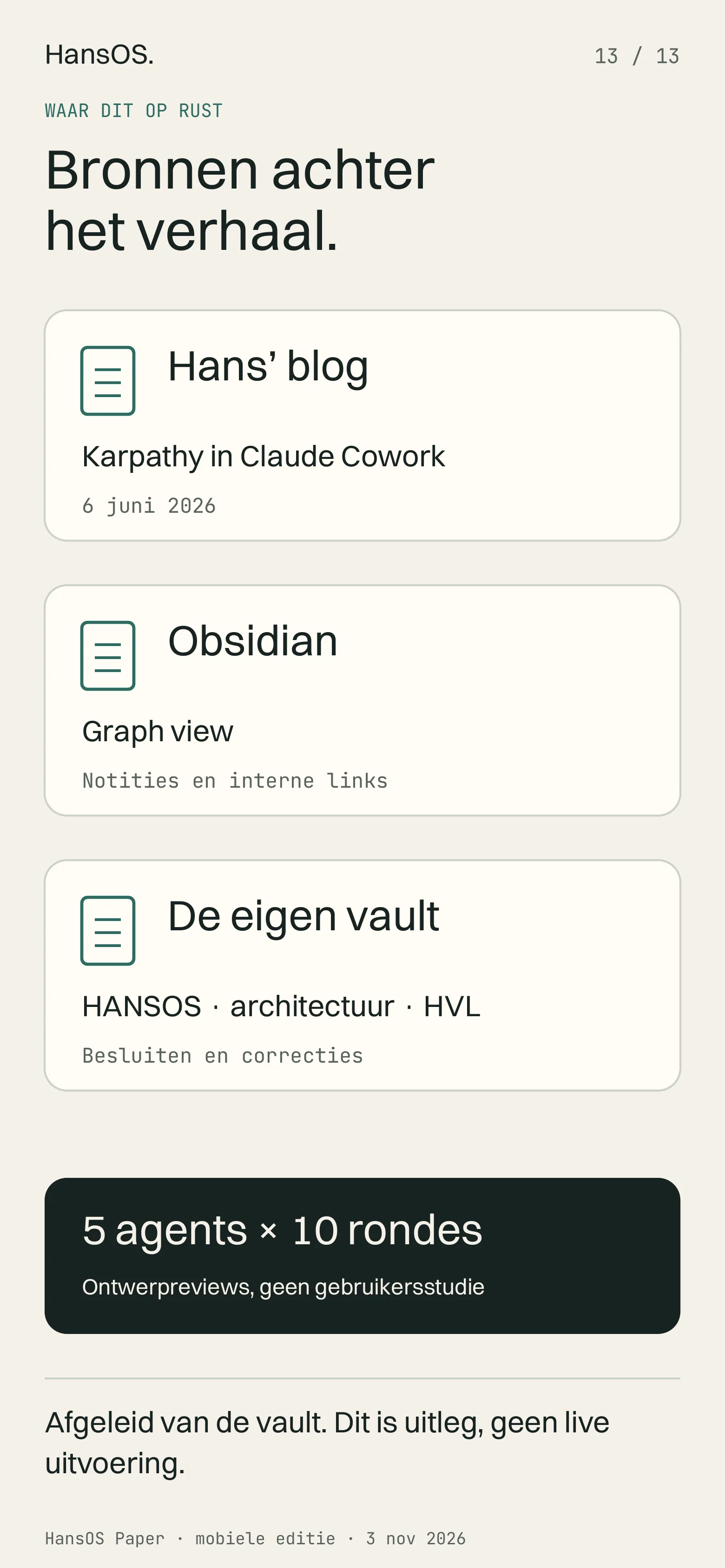
Swipe or scroll sideways, or use the arrow keys. Click or tap a page to enlarge it. The pages are in Dutch. SecondBrain in beeld (SecondBrain in pictures), mobile edition, 3 November 2026.
About the paper and the visual explainer
The working paper describes HansOS as an architecture: six functional layers, a workflow in eight steps, a human review that is bound to the content of the work and a knowledge base in plain Markdown. Version 0.4 of 24 November 2026 adds fieldwork from November, a cost overview and seven steps towards a scientific publication. The paper is written in English. It is a working version: not submitted and not peer reviewed. A few technical details have been made unreadable.
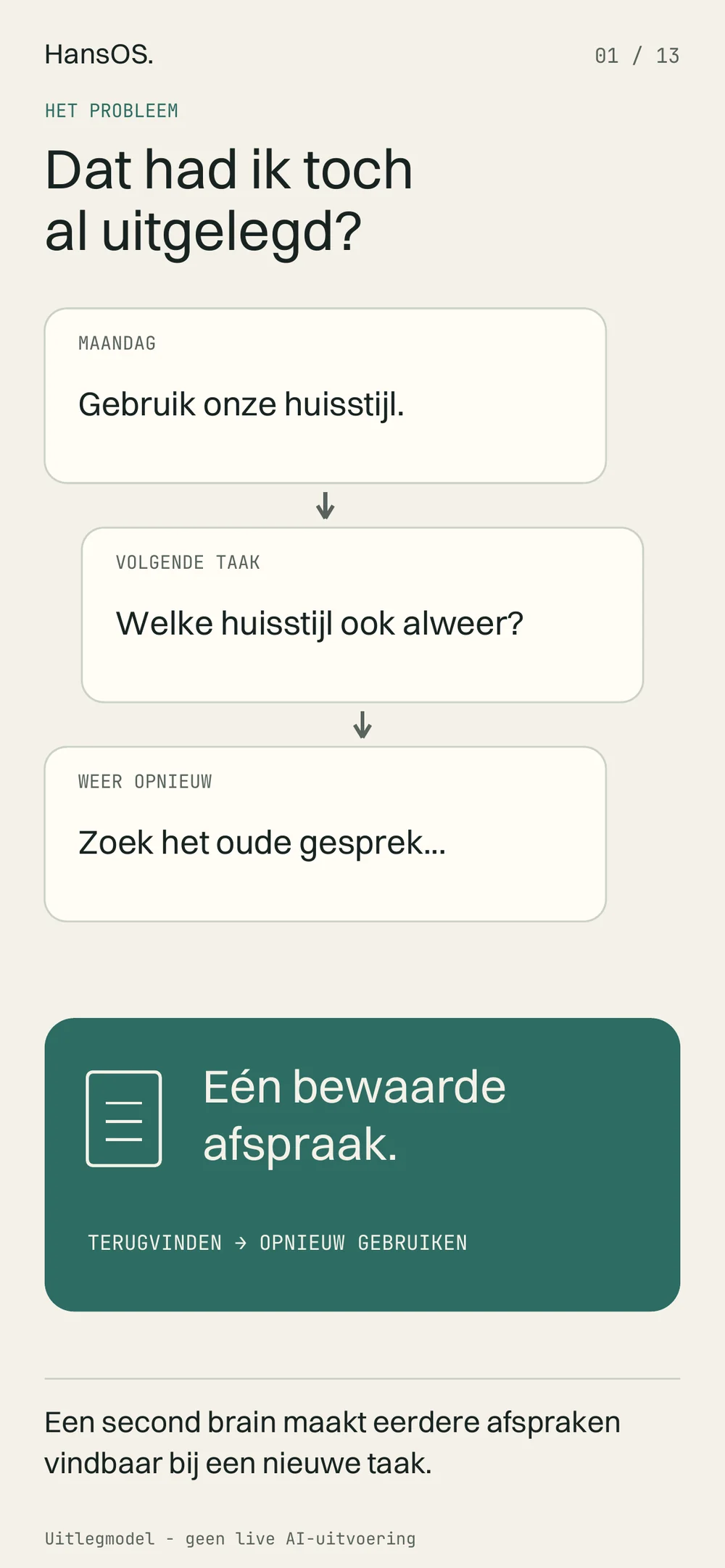
The pages above are the visual explainer of the knowledge base behind HansOS, the SecondBrainVault. In thirteen pages I show how work gets a memory: from the problem (“didn't I already explain that?”) to a first step you can take yourself, on page 12. The screens are illustrations, not a live AI run. The explainer says so itself. The pages are in Dutch; each one is described in English in its image text.
What it is, and what it is not yet
Not software that improves itself. Lessons are chosen and recorded by a person.
The limits, in three lines
What it is
A way of working and a knowledge base that I use myself every day, for e-commerce, design and music.
What it is not
Software that improves itself. Lessons are chosen and recorded by a person.
What is still open
A full endurance test and a recovery test of the first version. Until those pass I call it a working edition.
Under the hood
Under the hood runs self-hosted n8n for orchestration, Supabase Postgres as the data layer and a language model behind a human review. On an assignment I build on the client's infrastructure and accounts. After delivery the operation stays with the client, with documentation, access and monitoring.
Sources. The design book of HansOS (working edition, October 2026), the working paper HANSOS-TR-2026-01 (version 0.4, 24 November 2026, available to download here), the visual explainer (mobile edition, 3 November 2026, readable on this page) and the state of my knowledge base on 15 November 2026. The two failures are described in articles on this site, published on 16 August 2026 and updated on 14 October 2026. Every figure for those two failures comes from those articles.