Vendor or seller on Bol.com: how I ran the numbers at Alpine
At Alpine Hearing Protection we moved from vendor to seller on Bol.com. The calculation per product group, what I underestimated (returns, Buy Box, content) and when I would stay vendor.

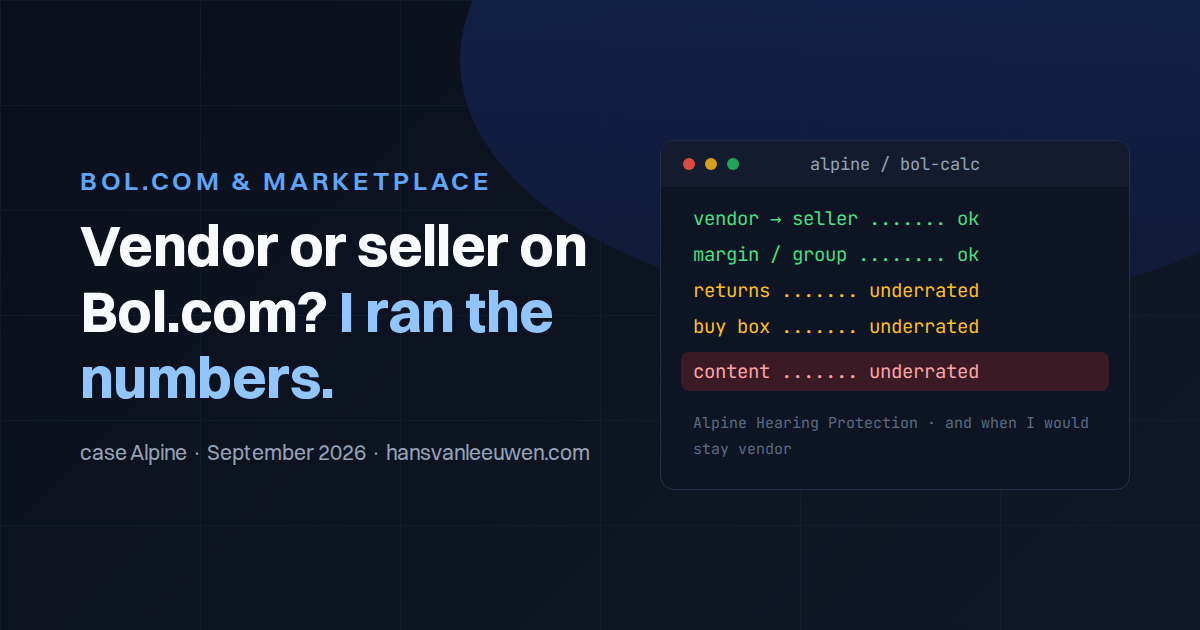
At Alpine Hearing Protection I faced the choice every brand manufacturer on Bol.com runs into at some point: keep supplying as a vendor, where Bol.com buys your product and sells it itself, or switch to the seller model, where you are the merchant on the platform. We switched. This is what the calculation looked like, what I got wrong, and when I would now stay a vendor after all.
Why the question came up at all
As a vendor you have a comfortable life. Bol.com buys, you deliver to their warehouse, done. But you have no say over the consumer price, you only see your own data through the window Bol.com chooses to open, and as soon as a competitor negotiates a sharper purchase price, your product disappears from view without you being able to do anything about it. For a brand that wants to protect its pricing across several channels, that is not a detail but a structural problem.
The seller model gives all of that back: you set the price, you see your conversion and your search visibility per product, and you can run your own ads. In return you do the work: content, stock, returns, customer questions and the commission on every sale.
The calculation
I ran the numbers per product group, not for the whole range at once. In hindsight that was the most important decision, because the outcome differed per group.
The comparison per product sold
The gross margin looked better as a seller. Net, the difference was smaller than it seemed.
On the vendor side: selling price minus the purchase discount Bol.com negotiates, minus your contribution to the promotions vendors co-fund. On the seller side: selling price minus commission, minus shipping or fulfilment, minus returns, minus the time you put into content and ads yourself. I forgot that last one in the first version of the calculation, and it is the mistake I see others make most often.
What I underestimated
Three things. As a seller, the returns flow costs more time than money, and time was not in my first spreadsheet. The Buy Box: as a seller you suddenly sit next to other merchants selling your own product, and without aligning prices with your B2B channels you get in your own way. We later did the same alignment for Amazon at Alpine, and it reduced price volatility in the Buy Box. And the content: as a vendor a mediocre product page is Bol.com's problem, as a seller it is your conversion.
What I overestimated: the complexity of the logistics. Once the shipping and returns rules were in place, it ran without daily attention.
When I would stay a vendor
Not everyone should switch. Stay a vendor if you have a small range with high volumes that Bol.com itself pushes hard, if you have no capacity for content and customer questions, or if your margin simply cannot carry the commission. And the hybrid model exists too: part of the range as a vendor, the rest as a seller. For brands with a broad range that is often the smartest first step.
What happened next
The switch gave us the data and the price control we were missing. We automated the content through Channable, so a change in one source landed on every channel at once.
Facing this choice yourself? I run the calculation per product group as a fixed-price project (from €2,500, excl. VAT), including the advice on which part of your range belongs where. More about that approach on the Bol.com consultant page.
Want to spar about your marketplace strategy?
No hype. A sober look at where your growth is and where margin leaks away.
Get in touch